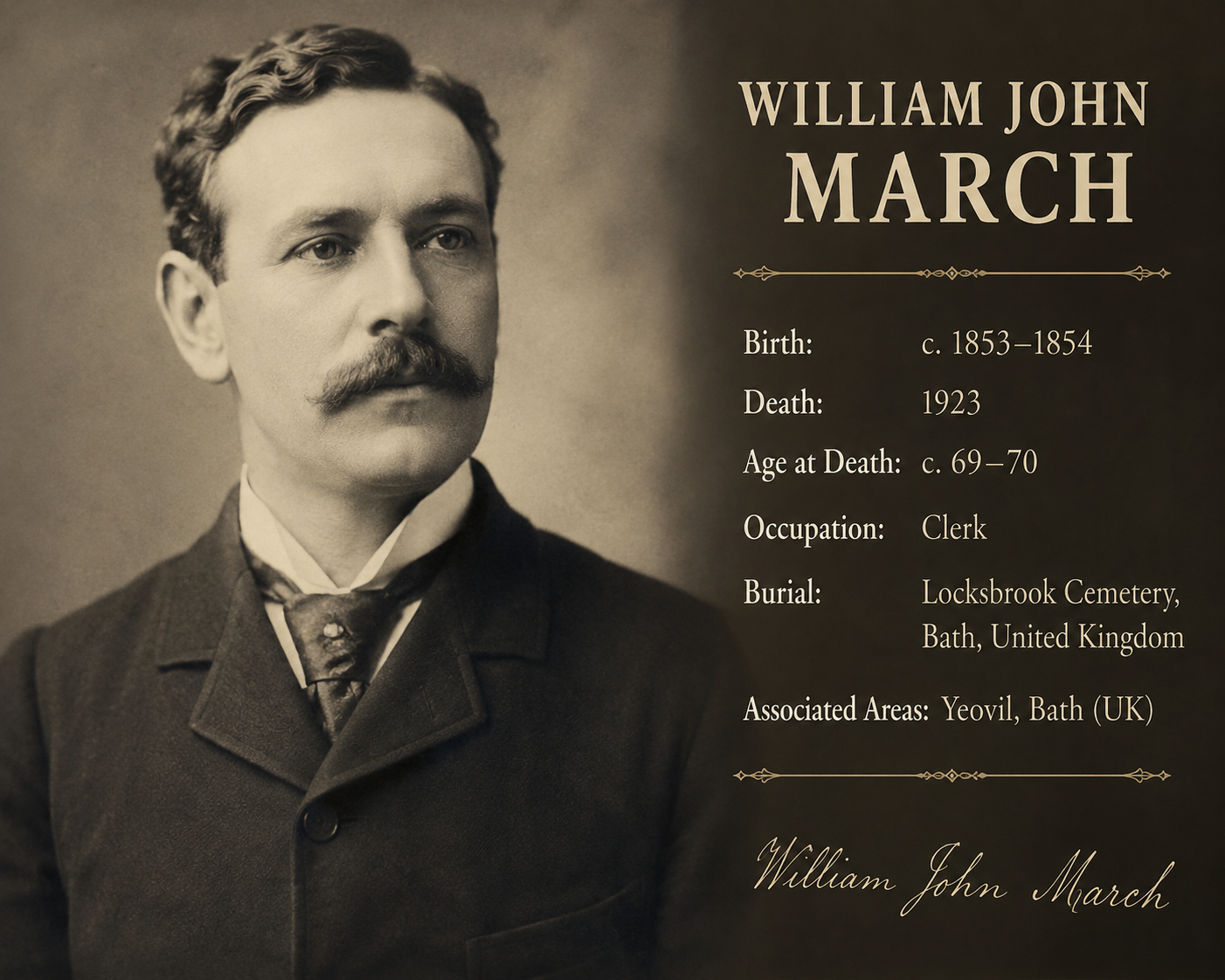
William John March: A Fragmented UK Genealogy Record Analysis
Introduction: A Historical Identity Built from Fragmented Records
The name William John March appears across multiple UK genealogy platforms, including census indexes, burial registries, and ancestry databases. However, despite repeated references, there is no single authoritative biography that fully confirms his complete life story.
Instead, his identity is reconstructed through fragmented archival traces scattered across different historical systems. These include civil registration records, burial documentation, and user-submitted genealogical data.
This creates a common challenge in historical research: separating verified facts from incomplete or inconsistent data across multiple sources.
The purpose of this article is to consolidate available information, highlight verified records, and explain why a fully unified biography of William John March does not currently exist.
Quick Genealogy Summary of William John March
| Category | Information |
|---|---|
| Full Name | William John March (also appears as William John March-Hunnings in some records) |
| Estimated Birth | 1853–1854 (varies across records) |
| Death | 1923 |
| Age at Death | Approx. 69–70 years |
| Occupation | Clerk (unverified specific role) |
| Burial Location | Locksbrook Cemetery, Bath, United Kingdom |
| Associated Areas | Yeovil, Bath (UK) |
| Key Sources | FindAGrave, Ancestry, FamilySearch, Bath archival records |
Who Was William John March?
William John March is recorded in various UK historical documents from the late 19th and early 20th centuries. His presence appears primarily through census fragments, burial records, and civil registration entries.
However, these records do not form a continuous or fully verified biography. Instead, they represent isolated data points that require careful interpretation and cross-referencing.
Because of this, his identity is best understood as a partially documented historical figure rather than a fully reconstructed biography.
Verified Historical Records and Source Evaluation
Understanding William John March requires analyzing the reliability of each genealogy source.
Civil Registration and Census Records (High Reliability)
UK civil registration records and census data provide the strongest evidence of his existence. These records confirm:
- Approximate birth period (1853–1854)
- Presence in UK census data
- Death registration around 1923
However, even these records may contain transcription variations or incomplete entries.
Burial Records (Moderate Reliability)
Burial documentation from Locksbrook Cemetery, Bath confirms:
- Death year (1923)
- Burial location
- Memorial listing under his name
While burial records are generally reliable for confirming death, they rarely provide detailed biographical context such as occupation or family structure.
Genealogy Databases (Variable Reliability)
Platforms such as Ancestry and FamilySearch include:
- Indexed census entries
- Family tree submissions
- Historical document transcriptions
However, these platforms rely heavily on:
- User submissions
- Automated indexing systems
- Secondary interpretations of historical records
As a result, inconsistencies are common, especially in name matching and family linkage.
Memorial Index Platforms (Lower Reliability for Biography)
Websites like FindAGrave provide:
- Burial location confirmation
- Memorial contributions from users
However, these entries are not always verified through primary documents, making them less reliable for detailed biographical reconstruction.
Identity Variations and Naming Inconsistencies
A key challenge in researching William John March is the variation in recorded names across archival sources.
He appears under multiple variations, including:
- William John March
- William John March-Hunnings
These inconsistencies may be caused by:
- Marriage-related surname changes
- Historical transcription errors
- Digitization mismatches in archival systems
- Merging of similar historical identities in databases
Because of this, some records may represent the same individual under different names, while others may refer to separate individuals entirely.
Timeline Analysis: What Can and Cannot Be Confirmed
Confirmed Timeline Points
- Birth: circa 1853–1854
- Death: 1923
- Burial: Locksbrook Cemetery, Bath, UK
Unverified or Missing Information
- Childhood and education details
- Full employment history
- Residential movements over time
- Family structure and relationships
- Social or civic involvement
This results in a partial historical timeline with significant gaps, which is common in 19th-century genealogy research.
Occupation: The “Clerk” Classification
Records commonly list William John March as a clerk, but no detailed employment records confirm the exact nature of his role.
In historical UK context, clerical positions could include work in:
- Government administrative offices
- Railway companies
- Legal documentation and court offices
- Commercial accounting and trade firms
Due to missing employment records, his specific professional background remains unverified.
Family and Relationship Records: Uncertain Linkages
Family relationships connected to William John March remain inconsistent across genealogy platforms.
Common issues include:
- Conflicting spouse or child listings
- Incomplete family tree structures
- Duplicate or merged identities in databases
- Lack of primary source confirmation
Because of these issues, any family connections should be treated as probable but not definitively verified unless supported by multiple matching records.
Geographic History: Yeovil and Bath Connections
Available records associate him with several UK locations:
- Yeovil – possible residence or administrative record area
- Bath – confirmed burial region
- Locksbrook Cemetery – final resting place
However, there is no fully documented migration record explaining:
- Movement patterns between these locations
- Duration of residence in each area
- Whether all records refer to a single individual or multiple individuals with similar names
Why Genealogy Databases Show Conflicting Data
Conflicting records across genealogy platforms are common and typically result from:
- Degraded or incomplete historical records
- Manual transcription errors during digitization
- User-generated family tree inaccuracies
- Lack of centralized identity verification systems
- Merging of similar historical individuals
These factors often create overlapping or partially duplicated identities across databases.
Why a Fully Verified Biography Does Not Exist
Search engines and genealogy tools cannot produce a complete biography of William John March because:
- No single authoritative historical profile exists
- Records are fragmented across multiple archives
- Primary documentation is incomplete
- No consolidated academic or encyclopedic entry exists
- Identity verification across sources is inconsistent
As a result, all available information remains interpretive rather than definitive.
FAQs: William John March
Who is William John March?
William John March appears in genealogy and historical records, but there is no single verified or fully documented biography that combines all available information into one complete profile.
Is William John March a real historical person?
Yes, the name appears in official genealogy databases and burial records, but the available information is fragmented and not consolidated into a fully verified historical biography.
Why is it difficult to find complete information about William John March?
Because his records are scattered across multiple genealogy platforms such as Ancestry, FindAGrave, and FamilySearch, with no unified or authoritative source combining all details.
Is William John March the same as William John March-Hunnings?
Some genealogy entries suggest a possible connection, but there is no fully confirmed or universally verified record proving they are the same individual.
What is the birth and death information of William John March?
Based on available records, his estimated birth is around 1853–1854, and his death is recorded in 1923. However, these details vary slightly across different sources.
Why do different websites show different details for William John March?
Different genealogy platforms rely on historical records, user submissions, and archival indexing, which can lead to inconsistencies in spelling, dates, and identity matching.
What was the occupation of William John March?
He is listed as a “clerk” in historical records, but there is no detailed information specifying the exact type of clerical work or organization he worked for.
Where was William John March buried?
Records indicate he was buried at Locksbrook Cemetery in Bath, United Kingdom, based on available burial and cemetery archive listings.
Why does Google show limited information about William John March?
Because there is no single authoritative biography or structured knowledge graph entry, search engines cannot generate a complete or fully verified profile.
What should researchers do when studying William John March?
Researchers should cross-check multiple genealogy databases, compare archival records, and treat each source carefully due to inconsistencies and fragmented historical data.
Conclusion: A Case Study in Fragmented Genealogy
William John March represents a typical case of fragmented historical identity reconstruction, where multiple archival sources provide partial but inconsistent information.
While key facts such as birth period, death year, and burial location can be confirmed, the absence of a unified record prevents the formation of a fully verified biography.
This case highlights a broader reality in genealogy research: many historical individuals survive not as complete life stories, but as scattered archival fragments that must be carefully interpreted across multiple sources.