
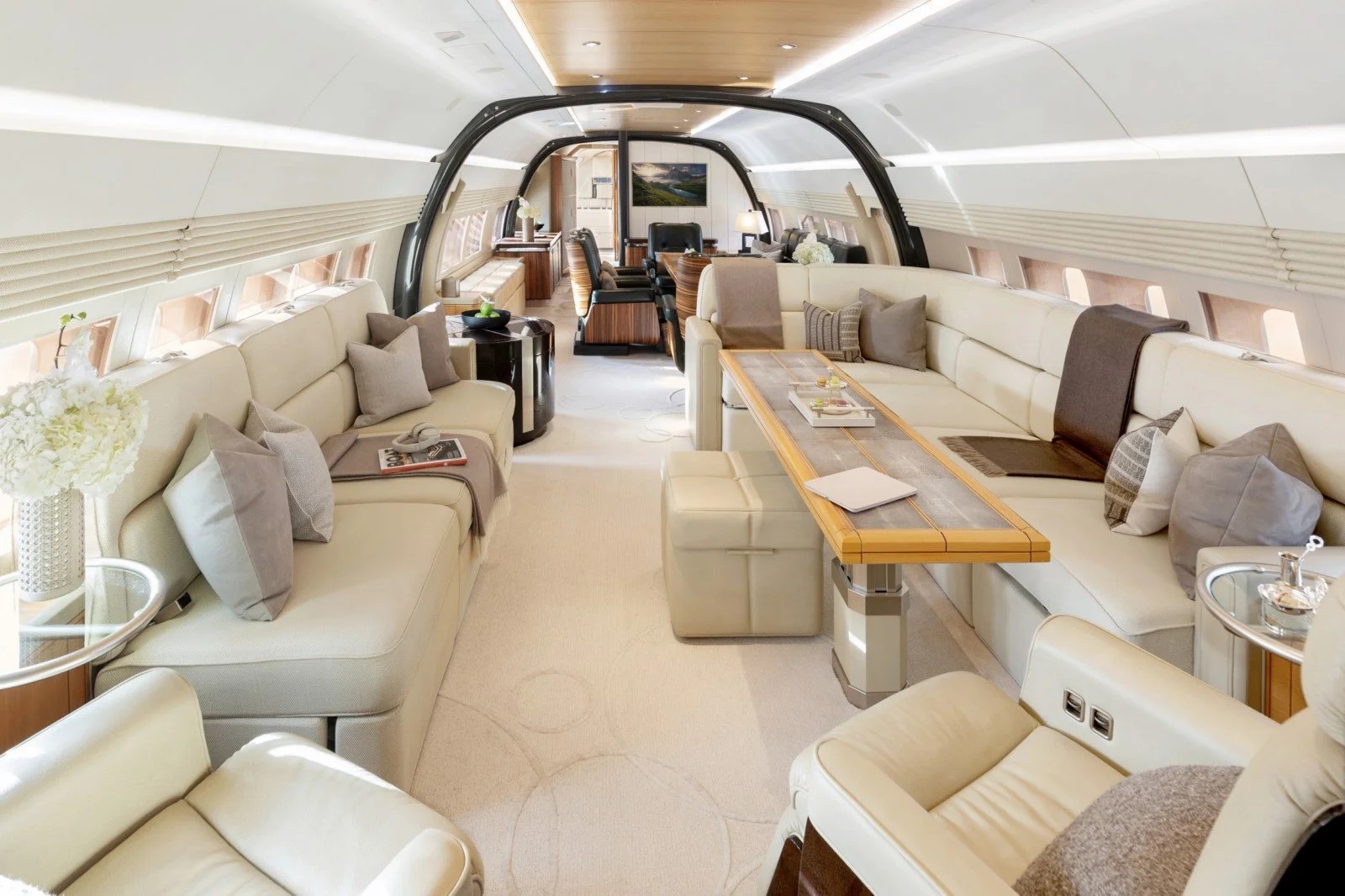
Inside the Modern Jet Cabin: Features Shaping Private Travel
Private aviation hasn’t changed because people suddenly wanted more luxury. It changed because the way people travel privately has become more varied, more frequent, and more personal. That shift shows up most clearly inside the cabin. When people talk about luxury private jet interior design today, they’re talking about whether the cabin supports how they actually move through a flight, whether short hops feel as considered as long ones, and whether the space adapts easily to your needs.
Cabins that are multi-purpose.
One of the most significant changes in private travel is that cabins no longer serve one purpose per flight. A single journey might involve conversation, quiet time, a short rest, and then conversation again. Older interiors often assumed one dominant activity. You were either sitting upright or fully reclined. You were either social or private. There wasn’t much in between.
Modern cabins now work for overlap. Imagine boarding a jet where one person settles into a quiet corner almost immediately, another remains upright and alert, and a third moves between the two throughout the flight. The modern cabin allows different states to coexist.
This shows up in subtle ways. For example, you’ll have seating angles that vary slightly across the cabin. Sightlines are softened, allowing you to feel present without being on display. Basically, the space doesn’t need to be rearranged every time someone’s needs change. It just works automatically.
From luxurious objects to more comfortable systems.
Earlier private jet interiors were often designed around standout pieces. You probably had a statement sofa, a dramatic table, and expensive carpeting. And sure, you have that still. The features haven’t gone anywhere. But they’re no longer the central point of a jet.
Take seating, lighting, and storage. In modern cabins, these aren’t separate decisions. Seating height affects how the lighting hits the face. Storage placement affects how often people stand up. Designers now consider these relationships rather than designing each component in isolation.
Business jets have quietly led the way.
A lot of these changes were tested in business jet interiors before coming into wider use in private aviation.
You see, business jets always operate on tight schedules, with passengers who value efficiency as much as comfort. That environment forces clarity. Anything that slows movement, distracts attention, or introduces friction is pushed out and modified immediately.
As a result, business jet cabins began focusing on predictability. Seats that return to position reliably. Storage that opens without blocking access. Controls that behave consistently across different aircraft. These practical improvements are precisely what frequent flyers appreciate.
Over time, the lessons carried over. Private jet cabins began borrowing the same discipline, even when aesthetics were more flexible. Comfort became operational.
Movement is a feature too.
One of the most noticeable features of modern cabins is how they handle movement. People don’t walk much on aircraft, but when they do, awkward layouts make it obvious.
Modern cabins are designed around these micro-movements. Clear paths are established between different sections of the cabin. Furniture is pulled back from walk lines. Floor finishes are soundproof. You can get up, pass someone, or return to your seat without the awkward half-turns that older cabins demanded.
This matters more than people realize. A cabin that allows easy movement feels less confining, even if its dimensions haven’t changed.
Tech controls should be more accessible.
Another feature shaping modern private travel is restraint in technology. Cabins still offer advanced controls, but they’re simpler to use. You’ve got one interface for everything.
And advanced technology doesn’t mean everything needs to be fancy. Sometimes, physical controls do what touchscreens can’t. And they’re much more accessible for everyone. And that’s what the modern cabin is focusing on: access.
You notice this when you don’t need instructions. The cabin doesn’t ask you to learn it. And that lack of interruption is intentional. Technology supports comfort only when it stays out of the way.
Consistency across different flights.
Modern private travel often mixes flight lengths. A thirty-minute hop might be followed by a five-hour sector the next day. And cabins now need to feel appropriate for both.
Designers handle this by avoiding extremes. Take seating, for example. Seating supports upright comfort without forcing it. Recline options exist, but they don’t dominate the layout. The cabin feels neutral enough to adapt.
This consistency is part of what makes modern private travel feel effortless. You don’t feel like the aircraft was designed for a different kind of journey. It adapts to the one you’re in.
Optimal ease.
If you strip everything back, modern jet cabins are basically optimized for ease. Ease of movement. Ease of rest. Ease of sharing space. Ease of understanding how things work.
The private jet cabin today is all about behaviour. It reflects how people actually travel now: often, informally, and with varied expectations from one flight to the next. The features are quiet refinements that remove discomfort.
That’s why the most advanced luxury private jet interiors don’t need to announce themselves. They simply work. They allow people to move naturally, rest briefly or deeply, and share space without negotiation. And in private aviation, that kind of ease has become the new definition of luxury.
Disclaimer
This article is intended for informational and editorial purposes only. The views and descriptions presented reflect general trends and observations in private jet cabin design and modern private aviation, and do not constitute technical, engineering, financial, or purchasing advice. Features, layouts, and technologies may vary by aircraft model, manufacturer, and operator. Readers should consult certified aviation professionals, aircraft manufacturers, or interior design specialists for specific guidance related to private jet acquisition, customization, or operation.