How Professional Bid Preparation Helps Contractors Submit Competitive and Profitable Proposals
Submitting a bid feels smooth on paper. Add up substances, upload difficult artwork, add a margin, and deliver it off. In practice, it truly is how contractors lose cash without ever noticing where it came from. A bid isn’t really some kind of; it is a wager on how an assignment will honestly unfold, and rushed bids now not frequently repay.
This article explains what separates a bid that wins the process and protects the margin from one that wins the job and quietly bleeds the business dry.
Why So Many Bids Miss the Mark
Most dropping bids aren’t misplaced on price on their own. They’re misplaced on obtain as authentic with the consumer senses the numbers do not add up, or the breakdown appears copied and pasted from a template. And the triumphing bids that become losses? Those typically trace back to portions that have been in no way properly checked.
Lumber Estimating Companies deal with this continuously on framing-heavy projects, in which a miscounted board piece or a preceding waste detail can quietly erase the entire earnings margin before the primary stud goes up. It’s not often dramatic. It’s just numerous things no one double-checked.
A bid constructed in a rush has a tendency to reveal it, one way or another.
The Hidden Cost of Rushing a Proposal
There’s a temptation to move rapid at the same time as a bid deadline is tight, and on occasion, tempo honestly matters. But rushing the estimate itself nearly normally fees greater than it saves.
Common shortcuts that come back to bite contractors:
- Reusing last 12 months’ fabric costs rather than checking current charges
- Skipping an internet site visit and relying completely on drawings
- Applying a flat markup for the duration of each line in preference to adjusting for risk every day with trade
- Leaving contingency out entirely to make the huge variety appearance extra aggressive
Each shortcut shaves a hint of time off the manner. Together, they shave masses more off the margin.
What a Skilled Construction Cost Estimator Actually Brings to a Bid
A bid constructed by someone familiar with the form, not without a doubt arithmetic, seems notable. It’s no longer constantly decreasing; often it’s more accurate, which on occasion may be barely higher; however, some distance can be a whole lot less likely to blow up mid-assignment.

A capable Construction Cost Estimator brings pattern recognition that is difficult to shortcut, built from having priced dozens of comparable jobs and knowledge of where the risk usually hides. That’s the type of judgment additives alone cannot mirror.
Consider a quick instance. A business contractor bidding on a mid-upward push maintenance had two versions of the same estimate organized, one completed fast in-residence, one reviewed with the resource of an out-of-doors rate estimator. The in-residence model came in at $4.3 million. The reviewed model came in at $4.6 million, after catching underpriced electric hard-in and a lacking allowance for permit delays. The client found the better amount due to the breakdown becoming more convincing, and the task finished within 2% of that revised budget.
Turning Estimate Accuracy Into a Competitive Edge
Here’s the detail most contractors overlook: being the most inexpensive bid isn’t absolutely the goal. Being the most credible bid is. Clients, mainly professional ones, can tell the distinction between a padded lowball and a wide range of it without a doubt is concept through.
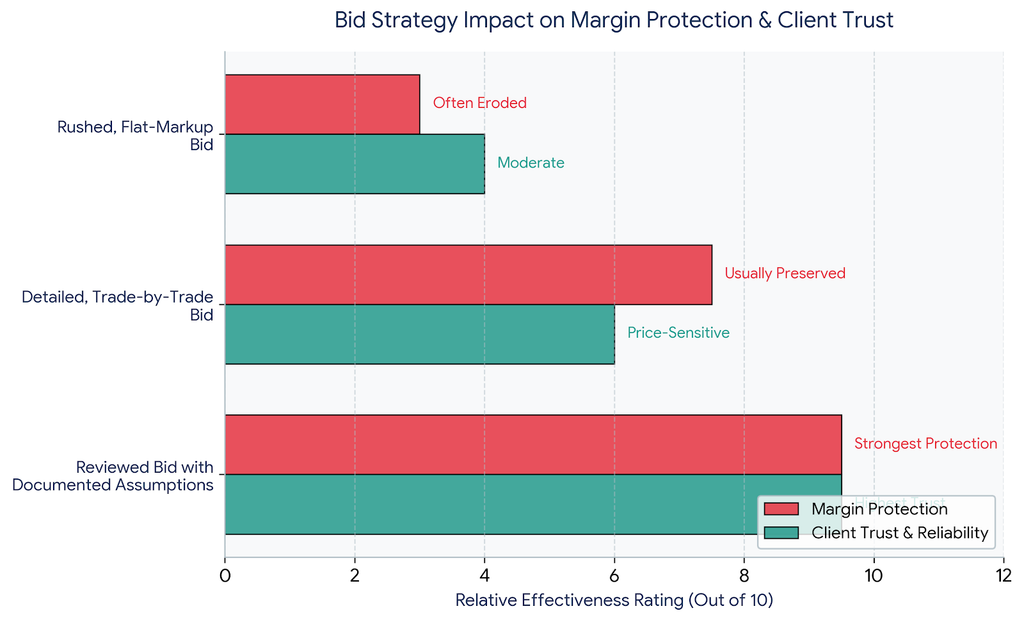
A table enables display how accuracy tends to shift the final results:
| Bid Type | Win Rate | Margin Protected |
| Rushed, flat-markup bid | Moderate | Often eroded |
| Detailed, trade-through trade-by-trade bid | Slightly lower win rate on price alone | Usually preserved |
| Reviewed bid with documented assumptions | Highest purchaser trust | Strongest protection |
Scaling Bid Preparation as Project Volume Grows
Handling 3 bids a month is capability with a spreadsheet and a careful eye. Handling fifteen a month is a one-of-a-kind problem, and most in-house techniques were not constructed for that leap.
Characteristics of a bid approach that scales without falling apart:
- Standardized templates that stay normal across estimators, so great does not go with the flow
- Historical fee databases that get updated after each closed undertaking, not just referenced from time to time
- Tiered evaluation, wherein smaller bids get a short look and large ones get complete scrutiny
- Clear turnaround benchmarks, so closing dates do not quietly erode accuracy under pressure
Contractors who plan for this scale before they hit it will be predisposed to increase without the painful stretch of scrambling to catch up.
Why Contractors Lean on Construction Estimating Companies for Bigger Bids
There’s a thing wherein internal functionality, without a doubt, isn’t always sufficient, specifically during a hectic season when three big bids land within the same week. That’s commonly when outside help starts to evolve, making monetary value in place of feeling like a vain fee.
Established Construction Estimating Companies deliver the bandwidth and specialized expertise to address bid surges without sacrificing the detail that protects margin, which matters most when time is short. The value isn’t always simply speed — it’s fast velocity without the corners being cut.
Tips for getting the most out of that shape of partnership:
- Give a clean path on which bids want the entire detail instead of a quicker examination
- Ask how they document assumptions, thinking about that transparency topic later
- Review a completed estimate collectively in advance, before it’s finalized, not after
- Track outcomes over several initiatives to see the actual go-back; no longer truly the primary one
What Separates a Profitable Bid Process From a Risky One
The significance of robust bid training is simple to underestimate till a task starts bleeding cash that the numbers in no manner accounted for. A profitable bid approach treats every assumption as something to protect, not genuinely some problem to submit. An unstable one hopes no one asks too many questions.
The distinction usually isn’t always skills. It’s difficulty checking portions two times, updating pricing regularly, and being honest about the chance in preference to hiding it in a flat markup.
Final Thoughts
Competitive bidding and profitable bidding are not opposites; however, they can line up when the numbers beneath the bid are honestly robust. Whether because of this that tightening internal assessment, bringing in specialized assistance for complicated obligations, or honestly slowing down enough to check the mathematics instances, the payoff shows up months later, when the venture closes near price range in desire to over it. A suitable bid isn’t always the one that wins quickest. It’s the simplest that still seems right after the bidding is carried out.
FAQs
How long does an intensive bid realistically take to prepare?
It is predicated upon cautiously on challenge length; however, a well-reviewed commercial bid frequently takes anywhere from a few days to two weeks. Rushing this timeline is commonly where accuracy starts to slide.
Does a higher-quality bid normally recommend a higher charge?
Not always. Sometimes a radical comparison lowers the rate by means of the usage of using catching hyped up line items, even though it more regularly protects against underpricing than it inflates the total.
Is outdoor estimating assistance clearly worth it for smaller contractors, not just huge corporations?
Yes, specifically at some point during busy seasons or for unexpected task types. The fee of outdoor help is usually a long way smaller than the cost of a single underpriced bid.
What’s the most important signal a bidding device dreams development?
Consistently winning jobs that later are available over price range. That pattern typically points back to the estimate itself, not to terrible execution on the net web page.