No-Code Game Makers for Creative Game Experiments
Creative experiments in game design rarely fit neatly into the kinds of carefully managed, high-stakes development cycles that traditional tools were designed for. They thrive instead in environments where failure is cheap, iteration is fast, and the overhead of just getting something playable doesn’t consume half your energy before you’ve even started testing ideas. No-code game makers have become the primary platform for exactly this kind of experimental work, not because they’re the most powerful, but because they remove enough friction to make genuine creative exploration actually realistic.
The Value of Cheap Failure
Why Experimentation Matters More Than Most Developers Admit
Game design improves through iteration, but iteration only happens if trying something new doesn’t cost a huge amount of time and energy upfront. A developer who can generate, test, and adjust a mechanic in thirty minutes will experiment far more than one who needs three days to implement the same variation. That difference in sheer volume of experiments attempted translates directly into better final design, since more attempts means more chances to discover something that actually works.
The psychological weight of that cost matters too. When building something takes significant effort, there’s real pressure to commit to a direction and ride it out rather than abandoning it when testing reveals a problem. Fast, cheap building removes that pressure, making it realistic to discard ideas that don’t hold up and pursue promising directions more deeply instead.
How No-Code Platforms Enable Experimental Thinking
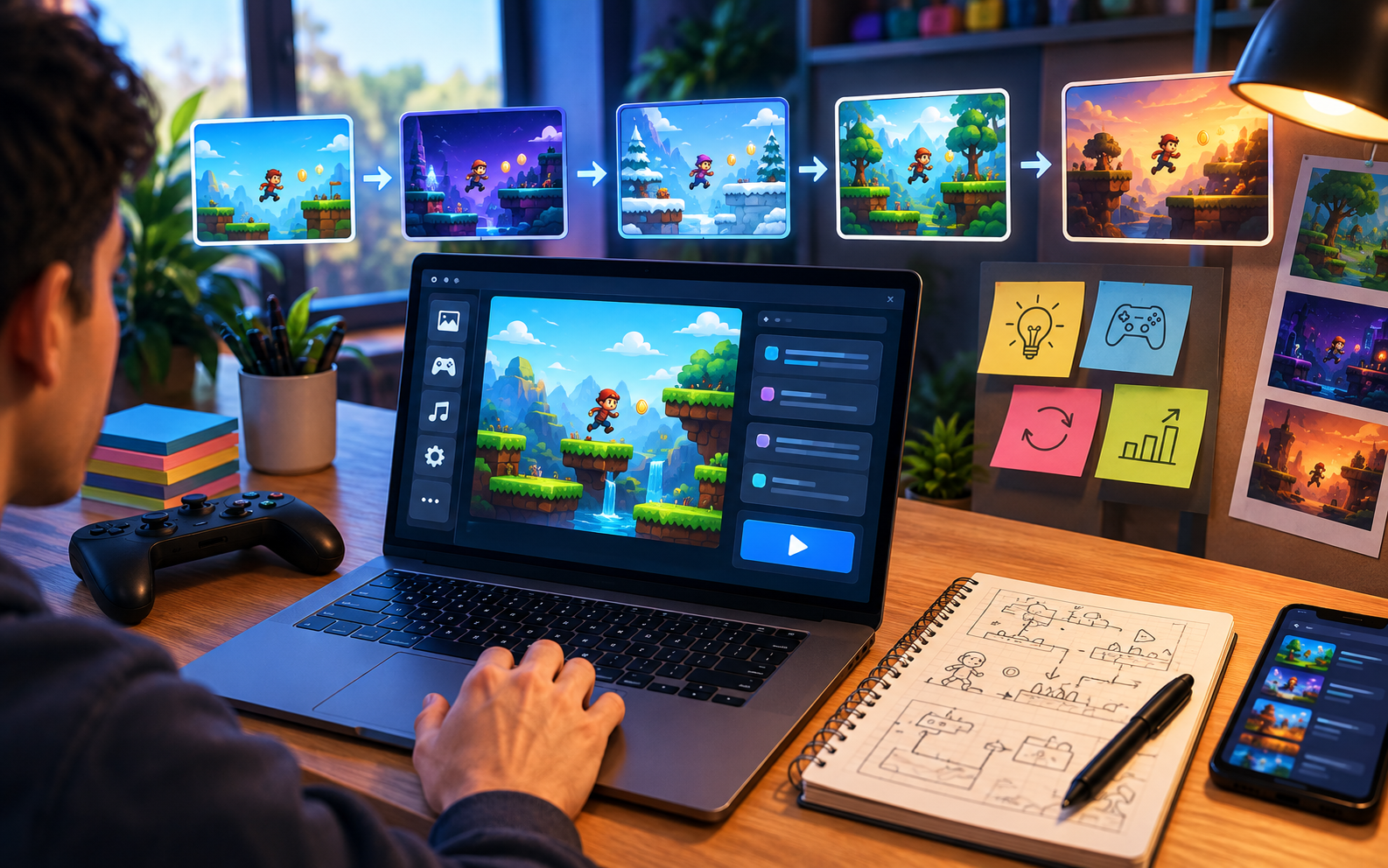
No-code game makers compress the distance between an untested idea and genuine playtesting so dramatically that experimental thinking becomes the default approach rather than something reserved for when time allows. You describe a concept, it becomes playable, you react honestly to how it feels, and you’re already moving to the next iteration before momentum fades. That tight feedback loop is what actually enables the kind of creative exploration that produces genuinely original work.
Setting Up for Productive Experimentation
Define Your Experimental Question Clearly
Before generating anything, know what you’re actually trying to learn from this experiment. Are you testing whether a specific mechanic feels satisfying? Whether a particular pacing approach works? Whether a combination of two systems creates interesting tension? Clear questions produce clearer results than vague experiments intended to “see what happens.”
Start Narrow, Expand Later if Warranted
The impulse in creative experimentation is often to try everything at once. Resist it. A single, focused experiment with one clear variable produces far more useful information than a kitchen-sink version where nothing is isolated enough to evaluate properly. Test one thing, learn from it, then layer in additional complexity.
Build Metrics Into Your Experimentation
Not rigid, quantified metrics, but clear ways to recognize whether an experiment succeeded or failed. “Does this feel fun?” is too vague. “Can a new player understand what to do within ten seconds without explanation?” is specific enough to evaluate honestly. Define what success looks like before you start.
Testing and Iteration Within Creative Experiments
Play Like a Real Player, Not as the Designer
After generating a version, step away from your designer brain for a moment and actually experience what you built. Notice where confusion appears, where boredom sets in, where things feel satisfying. This honest, player-perspective reaction is the actual data. Your designer intuitions come later.
Adjust One Variable at a Time
When testing, change one element, difficulty scaling, feedback timing, a specific rule, and nothing else. This isolates what’s actually producing the result you observe from what’s just different. Testing multiple changes simultaneously creates results too noisy to learn from.
Use Comparison to Accelerate Learning
Because generating variations costs relatively little time, generate two or three different approaches to the same problem, play them in quick succession, and directly compare which one felt better. That comparison teaches far more than playing each version in isolation weeks apart.
Games like Hole.io show what focused experimentation with a core concept can produce, a deceptively simple core mechanic that works because the specifics of how it responds, paces, and escalates have been refined through exactly this kind of iterative testing rather than guessed upfront.
Types of Experiments Worth Running
Mechanical Experimentation
Testing whether a specific rule, input method, or core action feels satisfying. Does timing pressure create the right kind of tension or just frustration? Does collecting small rewards feel as engaging as fewer, larger rewards? Does player skill genuinely determine outcomes or does randomness dominate? These experiments reveal what actually drives engagement in a specific concept.
Pacing Experiments
Testing how difficulty should escalate, how long a session should last, whether downtime or constant pressure feels better. Pacing experiments often reveal that what felt right on paper produces a completely different experience in actual play, and only honest testing catches that gap.
Aesthetic and Feedback Experiments
Testing different visual styles, sound designs, or feedback approaches for the same mechanic. Does instant feedback feel better than slightly delayed? Does visual polish matter for a simple concept or is rough-and-ready equally effective? These experiments separate genuine requirements from assumptions.
Social and Competitive Experiments
Testing whether a mechanic feels better when played solo or with others, whether comparison or cooperation creates more engagement, whether real-time or turn-based interaction fits the core loop better. Social dynamics often matter more than mechanics themselves for whether people want to return to a game.
Narrative Integration Experiments
Testing whether a story layer enhances or distracts from the core mechanic, whether lore deepens engagement or adds noise, whether character-driven or mechanics-driven presentation suits this particular concept. Narrative experiments are especially valuable because narrative choices often feel like they should matter more than they actually do.
What Experimentation Requires From You
Honesty About What’s Actually Working
The hardest part of experimental game design isn’t generating ideas, it’s being willing to recognize when an idea isn’t holding up and moving on. Ego attachment to a concept often prevents creators from honestly evaluating whether it’s genuinely fun or just familiar. Fighting that bias is part of the skill.
Patience With the Messy Middle
Experiments rarely produce finished products immediately. Expect to run dozens of small tests, discard several directions, and iterate through several versions of a promising concept before anything feels genuinely good. That messy middle is where learning actually happens, and rushing through it skips the valuable part.
Willingness to Document and Learn
Keeping notes on what each experiment revealed, what worked, what didn’t, and why matters far more than most creators realize. Those notes compound across projects, building a personal design intuition that becomes increasingly valuable over time.
Sharing Experiments Early
Experiments are only truly useful if you get outside reactions to them, not just your own internal evaluation. Share rough versions with other creators or players who don’t already know your intent. Their honest first reactions often reveal things you genuinely can’t see from the inside.
When Experimentation Becomes a Project
At some point, an experimental direction starts feeling promising enough to develop more seriously. Knowing when to make that shift, from quick testing to deeper development, is a judgment call. Generally, wait until a core mechanic consistently holds up under honest testing, until outside players have validated that it’s engaging, and until you understand exactly what makes it work well enough to polish it intentionally.
The shift from experimentation to development is when create a game in a more production-oriented way makes sense, once you’re confident in the direction enough to justify putting real effort into polish and refinement.
Final Thoughts
No-code game makers have democratized creative game experimentation by making the cost of testing an idea low enough that experimentation becomes the default approach rather than a luxury. The platform removes enough friction to let genuine exploration happen, which is exactly the condition under which original, interesting game design emerges.
Start with clear experimental questions, test one variable at a time, and share early for honest outside reactions. That disciplined approach to experimentation, supported by tools that make rapid iteration actually realistic, is what separates creators who produce genuinely original work from those who endlessly refine variations on existing ideas.