
Imagine learning to predict the outcome of a chess game — not after the final move, but after every single move throughout the match. With each new position, you update your prediction based on what you now know. This is the core intuition behind Temporal Difference (TD) Learning, one of the most influential ideas in reinforcement learning.
TD learning is a method where an agent continuously refines its predictions by comparing successive estimates rather than waiting for a final result. It sits at the intersection of two classical approaches: Monte Carlo methods, which learn from complete episodes, and dynamic programming, which relies on a full model of the environment. TD learning borrows the strengths of both and sidesteps their limitations.
For anyone pursuing an artificial intelligence course in Mumbai, TD learning is a foundational concept that unlocks a deeper understanding of how modern AI systems like game-playing agents, recommendation engines, and robotics controllers are trained.
The Core Idea: Learning from Prediction Errors
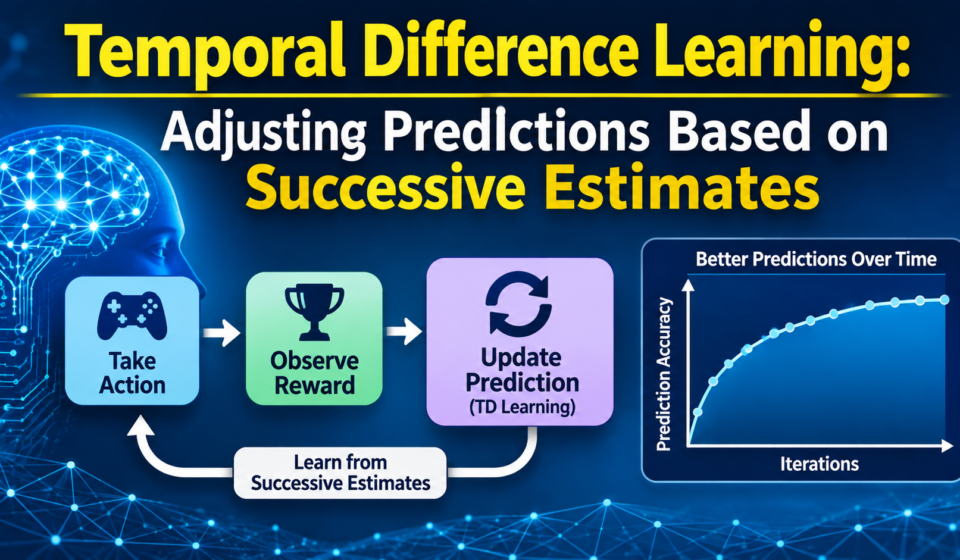
At the heart of TD learning is a deceptively simple equation. An agent makes a prediction about future reward, then observes what actually happens next, and updates its original prediction to close the gap between the two.
This gap is called the TD error — the difference between what the agent expected and what it experienced one step later. Mathematically, it is expressed as:
TD Error = (Reward + discounted future estimate) − current estimate
The agent then nudges its current estimate in the direction of this error, scaled by a learning rate. Over many iterations, predictions become increasingly accurate without needing to wait until the end of an episode.
This is precisely why TD learning is so powerful in environments that are long, continuous, or where outcomes are delayed. A self-driving car, for instance, cannot wait until a journey ends to learn whether its lane-keeping decisions were good. It must update its behavior at every moment.
TD(0), TD(λ), and the Eligibility Trace
The simplest form of TD learning is TD(0), where the agent updates its estimate based only on the very next time step. It looks just one step ahead and adjusts accordingly. While computationally efficient, this approach can be slow to propagate information across longer sequences.
To address this, researchers introduced TD(λ) — a generalization that blends single-step and multi-step updates. The parameter λ (lambda) controls how far into the future the agent looks when computing its updates. When λ = 0, the method reduces to TD(0). When λ = 1, it approximates Monte Carlo learning.
The mechanism that makes this work is the eligibility trace — a memory variable that tracks which states were recently visited and how relevant they are for the current update. States visited more recently (and more frequently) receive larger credit when a reward is received. This makes learning faster and more stable across complex environments.
Understanding these nuances is one of the reasons why hands-on labs are so valued in an artificial intelligence course Mumbai — working through TD(λ) implementations in Python makes the abstract mathematics concrete and intuitive.
Real-World Applications of TD Learning
TD learning is not just theoretical — it drives some of the most celebrated achievements in AI:
- Game playing: TD-Gammon, developed in the 1990s, used TD learning to reach near-expert level at backgammon purely through self-play. It demonstrated that an agent could master complex strategy without human-labeled data.
- AlphaGo and successors: Deep reinforcement learning systems like AlphaZero combine TD learning with deep neural networks to evaluate board positions and guide search — a technique that defeated world champions in Go and Chess.
- Robotics: TD methods train robotic controllers to balance, walk, and grasp objects by learning from streams of sensor data in real time.
- Finance: Algorithmic trading systems use TD-based models to estimate the value of holding or selling assets across multi-step time horizons.
These applications share a common requirement: learning from sequential experience, with feedback that is delayed and often sparse. TD learning handles this naturally.
Conclusion
Temporal Difference learning represents a elegant solution to one of the hardest problems in AI: how to learn effectively from experience when outcomes are not immediate. By adjusting predictions based on the difference between successive estimates, agents can learn continuously, efficiently, and without needing a complete model of their environment.
As reinforcement learning becomes increasingly central to modern AI systems, a solid grasp of TD learning is genuinely valuable. If you are considering an artificial intelligence course Mumbai, look for programs that cover reinforcement learning in depth — because understanding how agents learn over time is fundamental to building AI that performs reliably in the real world.