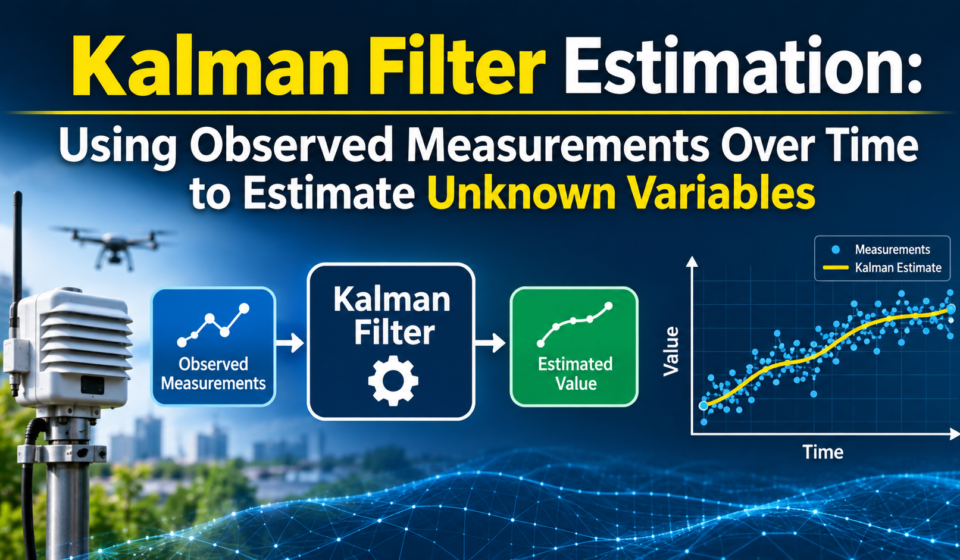

In real-world systems, what you measure is rarely the full truth. Sensors drift, signals are noisy, and the variables you actually care about—like a vehicle’s true position, a machine’s hidden temperature state, or a user’s evolving intent—often cannot be observed directly. Kalman Filter Estimation is a practical way to deal with this gap. It uses a stream of measurements over time, along with a model of how the system behaves, to estimate unknown variables more accurately than raw observations.
If you work in data, robotics, control systems, or ML engineering, learning the Kalman filter adds a powerful tool to your estimation toolkit. Many learners encounter it while pursuing an artificial intelligence course in Mumbai, because it sits at the intersection of probability, linear algebra, and real-time decision-making.
What Problem Does a Kalman Filter Solve?
The Kalman filter solves a common problem: how to infer the “state” of a system when your measurements are incomplete and noisy.
- State means the internal variables that describe the system, such as position and velocity for a moving object, or level and trend in a time series.
- Measurements are what you can observe, such as GPS readings, camera detections, or sensor voltages.
- Noise represents uncertainty—random errors in sensors and disturbances in the system.
A Kalman filter assumes you have:
- A process model describing how the state changes over time (even if imperfect).
- A measurement model describing how the state produces measurable signals.
- Reasonable estimates of uncertainty in both the process and measurements.
The key idea is not to “trust the sensor” or “trust the model” blindly. Instead, it blends both in a mathematically consistent way.
The Predict–Update Cycle
A Kalman filter runs in a loop, typically at each time step (every second, millisecond, or whenever new data arrives). The loop has two phases:
1) Predict
The filter uses the process model to forecast the next state. For example, if an object was moving at a certain velocity, the model predicts where it should be in the next time step. Along with the predicted state, the filter also predicts uncertainty—because uncertainty tends to grow when you rely only on a model.
2) Update (Correct)
When a new measurement arrives, the filter compares:
- The predicted measurement (what the model expected to observe), and
- The actual measurement (what the sensor reported)
The difference between the two is called the innovation or residual. The filter then updates the state estimate by applying a weighted correction. The weight is determined by the Kalman gain, which depends on uncertainties:
- If the sensor is very noisy, the filter leans more on the model.
- If the model is uncertain and the sensor is reliable, the filter leans more on the measurement.
This predict–update rhythm is why the Kalman filter is so effective in streaming settings. It does not need to store the entire history; it carries forward only the current estimate and its uncertainty.
Interpreting Uncertainty: Why It Matters
A major advantage of the Kalman filter is that it outputs not only an estimate but also a measure of confidence in that estimate. This is crucial in real systems.
For example:
- In autonomous navigation, you may want the system to slow down if position uncertainty grows.
- In industrial monitoring, you may trigger an alert only when the estimate is high-confidence.
- In tracking, you may choose to ignore weak detections that do not meaningfully reduce uncertainty.
This probabilistic view is one reason the Kalman filter appears in discussions alongside modern AI methods. In an artificial intelligence course in Mumbai, it is often used to explain how estimation and inference differ from pure prediction—especially in time-dependent systems.
Where Kalman Filters Are Used in Practice
Kalman filters are widely used because they are fast, stable, and interpretable.
Common applications include:
- Object tracking: estimating the position and velocity of a moving target from noisy detections (radar, camera, LiDAR).
- Sensor fusion: combining multiple sensors like GPS + IMU to improve accuracy.
- Robotics and drones: stabilisation and state estimation for control loops.
- Time-series smoothing: filtering noise while retaining genuine trends and shifts.
- Signal processing: cleaning measurement streams for downstream analytics or ML.
In many AI pipelines, the Kalman filter acts as a pre-processing or tracking layer that makes later decisions more reliable. That practical relevance is why you’ll often see it included in an artificial intelligence course in Mumbai that covers real-time systems or robotics.
Practical Tips and Common Pitfalls
Even though the Kalman filter is elegant, results depend heavily on setup:
- Model mismatch: If your process model is unrealistic, predictions drift quickly.
- Poor noise settings: The process noise and measurement noise values control how “stubborn” the filter is. Overconfidence in either model or sensor can cause unstable estimates.
- Uninitialised state: Starting with a bad initial state and tiny uncertainty can prevent the filter from correcting properly.
- Nonlinear systems: The classic Kalman filter assumes linear models. For nonlinear dynamics, practitioners use variations like the Extended Kalman Filter (EKF) or Unscented Kalman Filter (UKF).
A good workflow is to start simple, verify behaviour on known scenarios, and tune uncertainty values based on actual sensor behaviour. This tuning mindset is emphasised in hands-on training settings, including an artificial intelligence course in Mumbai, where learners typically validate the filter on tracking or sensor fusion exercises.
Conclusion
Kalman Filter Estimation is a foundational method for turning noisy, time-ordered measurements into stable estimates of hidden variables. By blending a predictive model with incoming observations—and tracking uncertainty at every step—it provides a reliable approach for real-time inference. Whether you are working on tracking, robotics, sensor fusion, or streaming analytics, understanding the Kalman filter gives you a practical edge and strengthens your grasp of probabilistic reasoning that modern AI systems still rely on, including what you may learn in an artificial intelligence course in Mumbai.